Incubatio Method
The Incubatio Method: Holonomic Field Inquiry
Memory,mirrors, metamorphosis
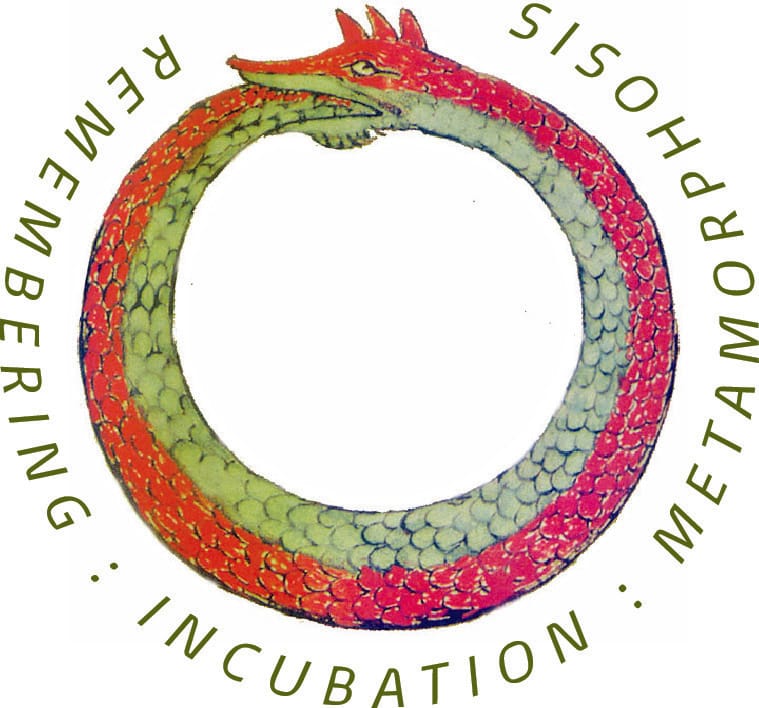
This underlying sacred triad exists in multiple ways as the pulse of Incubatio. It is repeated within the architectural structure itself, as an iteration between library and academy, building up the substance of Incubatio. It is repeated within the offerings of the academy, building up an evidence base, and bringing new forms and concepts into being. As it is repeated, it gains depth and profundity – opening up to the layers of the unconscious that lie beyond time and space. It is the beating heart that has been abandoned in our modern day abstractions - slow, careful and creative, whilst the possibility of fractal change opens, it provides a crucible for the vital composting to take place.
In what follows, I explore some of my experience of working in groups in many different contexts, researching into ways in which greater awareness can be brought into groups.
It became clear to me both as a psychotherapist, and as a teacher or facilitator, that real transformation only took place when something arose in the ‘middle’ as a shared transmission takes place. There is a resonance, or vibration that emerges from a joint inquiry, a felt shift that can be jointly expressed and needs both for its manifestation. It is a sense of connection, perhaps of jointly remembering. It is a point at which a metaphor, a picture, a myth, can emerge unbidden to express a shared reality that goes beyond words. When this happens, an archetype, and a deeper knowing enters the space; something shifts in our field of connection, in the dynamics and waves of the group. As my work has unfolded, I have come to think of this as a method of inquiry: an inquiry into our collective ways of becoming and knowing. We could call it a modern story-telling, a way of remembering and honouring the past and shaping the future in the present.
I call it 'embodied field inquiry' to capture the field and emergence of the new.
Embodiment
I call it ‘embodied’ since the instrument of inquiry is the participant’s own arising body-mind process as it meets that of another, or that of a group of people. The use of the term ‘embodiment’ emerged from a Buddhist understanding of the self process as a mutual arising of form, sensation, feelings, perceptions, mental activity, consciousness. Normally, we do not notice our participation in the shaping of our reality. We tend to think that we only react to what we perceive, without noticing how our thinking habits subtly influences our perceptions.
If, however, we can develop a mindful awareness of this process, we can see that the way in which we habitually perceive the world is shaped by our past perceptions and experiences. By tracking our own bodily sensations, emotions, thoughts as they arise in the moment then we begin to develop a witness awareness – a metalevel of engaging with the world that brings us into deeper presence, and ability to connect openly with ourselves, and other people – allowing something new to arise in the moment. This gives us the potential at any moment in time of bypassing our conditioned selves, and to bring an awareness to the multiple levels of ourselves as human beings. In terms of group inquiry it is a way of mirroring and reflecting back the other’s process, a revitalising of consciousness, and a reinvigorating of a shared purpose through a direct resonance with the other.
Field
‘Field’ denotes the focus of inquiry – it can be said to represent the liminal space in which matter and mind intersect. In the sense of group inquiry, the ‘field’ is the interpenetrating field of human consciousness, and I use it as an explicit explanatory and initiatory factor. It is not just an abstraction. The concept is being used in different disciplines to explain the emergence of form. In physics, for example, according to quantum field theory, there are various kinds of matter fields – electron fields, neutron fields and so on. The physicist Bohm suggested that an implicate (potential) universe is enfolded within the explicate (manifest), and it is only when consciousness (awareness) contacts the implicate that it collapses into form or manifestation. The biologist Sheldrake posited a radical theory of formative causation which suggests that self-organising systems including molecules, cells, tissues, organs, organisms etc. are made up of nested hierarchies or holarchies of holons, or morphic units. The wholeness of each level depends on an organising field and is a vibratory pattern of activity that interacts with electromagnetic and quantum fields of the system. These fields are shaped by morphic resonance from all similar past systems and contain a collective cumulative memory . Resonance depends on similarity, and does not change through distance in space or time. Jung’s concept of the collective unconscious implies also a notion of the field in psychology – an underlying organising field: ‘This substratum on which psyche resides is the collective unconscious – not just contents , but underlying structural patterns common to all human beings –psychic expression of the identity of brain structure irrespective of racial differences.’( Jung, p.88, 1931) Jung expressed this in terms of a ‘psychoid layer’ – a subtle field from which both matter and mind co-emerged. The idea of a ‘field’ then occurs in physics, biology and psychology, and is certainly echoed in many wisdom traditions, and latterly in recent times in the idea of the ‘akashic field’ according to theosophy and anthroposophy.
The process
The process of inquiry involves an iterative, repetitive process from which something new emerges. It echoes the principles of the work of the alchemists, and that of modern phenomenological research, such as methods of action research, or hermeneutical research, and involves a spiralling around, a cycling of a theme. Unlike traditional science, it actively involves the subjectivity of the observer. The instrument of observation, and the object of inquiry is the embodied individual within a context of relationship.
The inquiry itself can take place into different areas of experience such as: the early holding field (i.e. the field of relationships into which a baby is born); the ancestral field; the astrological field; or the family field. Whatever the object of our inquiry, by deepening into the older levels of consciousness, waves of information constellate into different patterns, and for a moment offer up insights that may be lying in the individual or collective memory, and then integrated in greater awareness.
The three-fold process of remembering, incubation and metamorphosis runs through the method, a weaving in and out of the past, present and future, recasting that in the individual or collective memory – a stepping into the alchemist’s crucible, or we could call it in more modern day language, a collective dipping into and out of the explicate field.
Whilst the process is inherently fluid, we can identify some underlying principles or steps, not necessarily followed in the same order, but which may be repeated many times within an inquiry.
Method steps
1 Setting up the field/crucible
2 Inviting in the archetypes (ancestral, spiritual)
3 Incubating ( Inviting in the memories, mirroring, reflecting)
4 Resonating ( Empathic resonance and compassion within the body and between group members)
5 Titrating ( Moving from one level of consciousness to another and witnessing the movement)
6 Integrating ( Consolidating, reflecting, re-reflecting)
7 Metamorphosing ( New perceptual patterns, new relationships to old memories)
There are many ways in which the field can be evoked, but the following describes one particular way of working in the ancestral field.
Steps 1,2: Setting the field energies/changing levels of consciousness
The group is invited to slow down breathing and drop into a meditative state. The energy is grounded through focusing attention on the spine, and its connection with the earth and sky above. Almost immediately, the level of consciousness drops entering into – as Jung would say – an ‘abaissement du niveau mental’ ( Rees, 2013) or this can also be described as a type of shamanic consciousness . Participants are then invited to bring to mind their ancestral field, or some other image of concentration, and to follow the feelings, sensations and thoughts as they arise in the body.
This ‘field’ that arises contains aspects that relate both to the early holding field, the ancestral field of individual participants, and also a cosmic field of archetypes. It is the field of memory that can be accessed in these deeper levels of consciousness.
Steps 3,4 5: Incubation
In this part of the inquiry, participants may share their experiences, in many different ways, tracking between the earlier level of consciousness, and the cognitive level required to frame the experiences at a verbal level. In my experience, and increasingly so, very deep suppressed emotions arise to the surface, which, in being witnessed by others, can be released and transformed.
Inevitably, the experience of shame arises, as this is the mechanism by which difficult memories are buried. Shame is the very base, and most complex emotion, and I feel the key to overcoming conditioning (Rees, 2017) The inquiry provides a place in which shame can be surfaced and tolerated, since the group is able to hear the experience, validate its reality. This is the process by which trauma processes can be healed. This may be mediated through the emergence of pictures, symbols, forgotten experiences from deep within the archetypal memory, as does an increasing sense of connection as the feeling of isolation that held the shame process in place is dissipated. This connection moves below the level of the conditioned self. One understanding in Incubatio is that only when these unconscious shame patterns have been surfaced, can a truly new form emerge - otherwise the shame patterns will subtly influence choices and behaviours. The group container offers a shared space where these can be mutually recognised and released.
In the field lie multiple layers of experience, woven between the archetypal structures. The facilitator’s role here is to hold the space, and ensure that participants are not moving into an overwhelmed place. In trauma work, this is working the edge of the ‘window of tolerance’. It is the skills of the old alchemist as he would stoke the flames of the crucible so that the base materials could fuse and re-emerge into the philosopher’s stone. It is the alchemist’s body that is the instrument for this to take place, and his or her ability to tolerate these states within themselves. Once recognised, they can be ‘named’ at any moment, either to create safety, or change the direction of inquiry. This is the process of titration.
Steps 6, 7: Metamorphosis
This is the process of integrating the forgotten memory into the bodily system, and will begin at the end of the group inquiry . It means that the new information/experience becomes incorporated into the arising self of each individual, so that their future perceptions and filters of viewing the world change. We are examining the construction and reconstruction of the self in the moment, and in its witnessing arises the possibility for the transformation of the self so that greater awareness – and hence expansion of consciousness can occur – what this means for each individual will be different, and will need processing individually outside. This will transform not only the individual, but this will also lead to a transformation in the group dynamics.
It provides the space for something new to emerge – a fractal change of state. Perhaps even a fourth level of consciousness.
It is a call to reconnect with the archetypes of the past – not as dead examples of a time long gone, but to listen to their whispers and to recognise that they still live amongst us, interweaving their wisdoms throughout the sometimes brutal technology of the digital age. This is the living process of legend and myth, a creation and recreation of the archetypes as they slowly unfold within their different manifestations in time and space, at the same time as enabling us to re-connect, re-cognise from that long-suppressed part of our consciousness. It is a homecoming. A coming home to self.